
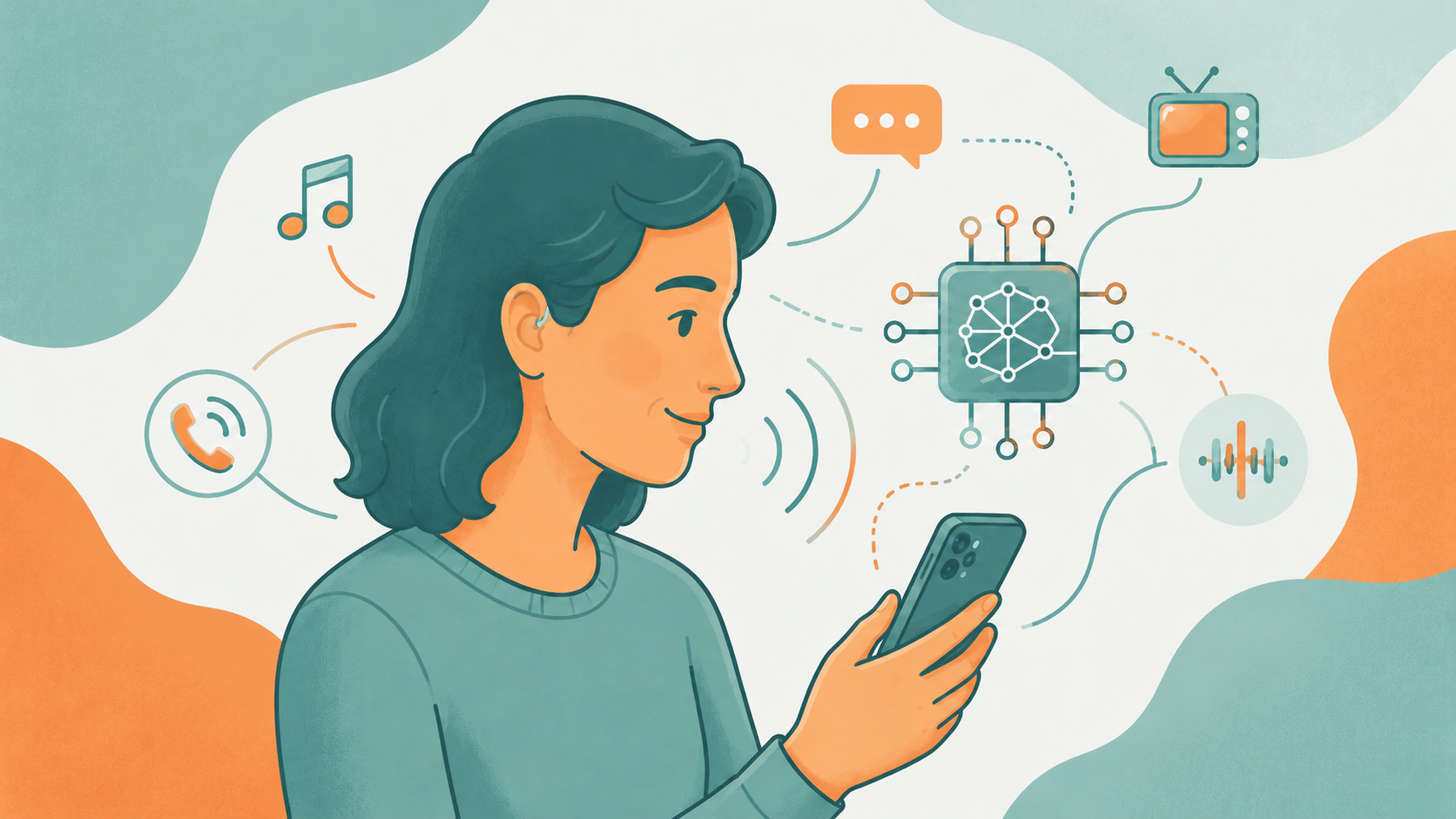
How AI is Revolutionising Hearing Aids
The Future of Hearing Is Already Here
Around 1.5 billion people worldwide live with hearing loss. Only a fraction seek help. Here is what today's AI hearing aids actually do differently.
You have asked someone to repeat themselves three times at dinner. You have turned the television up so loud that your partner now watches in a different room. You smile and nod in group conversations because asking people to repeat themselves, again, feels embarrassing.
If any of that resonates, you are in good company. According to RNID, around 18 million people in the UK live with some degree of hearing loss. More than half of adults aged 55 and above are affected, and the figure rises to 80 per cent of those aged 70 and older. Globally, the World Health Organisation estimates that 1.5 billion people live with hearing loss, with 430 million requiring rehabilitation services.
But here is what surprises most people: the technology available today bears almost no resemblance to the chunky, whistling devices many remember from their parents' generation. AI hearing aids in 2026 are discreet, intelligent, and genuinely designed around real life.
Why Do So Many People Put Off Getting Help?
Across many countries, people wait an average of around 10 years from first noticing a change in their hearing before speaking to a professional. Ten years of turning the television up. Ten years of missing punchlines. Ten years of smiling along in conversations followed only halfway.
The reasons are understandable. Many people assume hearing aids are bulky, obvious, or fiddly to manage. Others worry they will look older, or feel the hearing loss is not quite bad enough yet to do anything about.
A large independent survey of hearing aid users, EuroTrak 2025, found that:
- 82% of hearing aid users are satisfied with their devices, up from 75% in 2022.
- 96% say their quality of life improved after starting to wear them.
- Average daily wear time has risen to nine hours, reflecting how natural modern devices feel.
There is also a health dimension that few people realise. The 2024 Lancet Commission on Dementia identified untreated hearing loss as the single largest modifiable risk factor for dementia, raising the risk by up to 37 per cent. The same report noted that using hearing aids appears to reduce that excess risk.
Addressing hearing loss is not just about comfort. It is one of the most practical things a person can do for long-term brain health.
The gap between people who need hearing support and those who actually seek it is not about technology. It is about outdated assumptions. AI hearing aids in 2026 are smaller, smarter, and far more capable than most people expect.
What Does AI Do Inside a Hearing Aid?
To understand how AI-powered hearing aids work in 2026, it helps to understand what older devices did wrong.
Traditional hearing aids amplified everything. Louder conversations. Louder traffic. Louder clatter from the kitchen. The microphone did not distinguish between what you wanted to hear and what you did not. So busy environments often felt more overwhelming with a hearing aid than without one, which is why so many ended up sitting in a drawer.
AI changes this completely. Here is what happens inside a modern device:
- The processor analyses the sound environment thousands of times per second, identifying whether you are in a restaurant, a quiet room, a windy street, or a large hall.
- It separates speech from noise in real time, using speech-in-noise technology that focuses on voices while reducing background sound.
- It tracks direction, understands where sound is coming from, and adjusts its focus accordingly.
- It learns your preferences over time through machine learning, so the device gradually becomes more attuned to how you like to hear in different situations.
Some of the latest models use deep neural network processing, the same type of technology that powers voice assistants and facial recognition, to achieve a level of speech clarity that was simply not possible even five years ago.
The result is a genuinely personalised hearing experience that reduces the mental effort of listening, not just the decibels.
Which AI Features Make the Biggest Real-World Difference?
Not all AI features are equal. These are the five that hearing aid users consistently say change daily life most noticeably.
1. Speech in Noise Technology
This is the one that matters most to most people. Rather than amplifying everything, speech-in-noise technology automatically separates voices from surrounding sounds. At a noisy family dinner or in a busy cafe, the people talking to you come through clearly while the background noise stays where it belongs: in the background.
2. Automatic Scene Recognition
The best AI hearing aids adjust to your environment without you having to touch anything. Walking from a quiet hallway into a busy kitchen, or stepping off a quiet street into a supermarket, triggers automatic changes to how the device processes sound. No buttons, no app, no effort.
3. Own Voice Processing
Many first-time hearing aid users are surprised to find their own voice sounds strange or hollow when they first put a device in. Modern AI addresses this by processing your voice as a completely separate audio stream from external sounds. Your voice sounds like your voice again. This makes a significant difference to how quickly and comfortably you adapt.
4. Personalised Learning Through Machine Learning
Machine-learning hearing aids adapt over time by learning from your behavior. If you consistently turn the volume up slightly in certain places, or prefer one programme over another at certain times of day, the device starts to anticipate those choices. The longer you wear it, the more the device fits you rather than a generic hearing profile.
5. Cognitive Load Reduction
This is the benefit people often do not expect but talk about most once they experience it. Straining to follow conversations when hearing-impaired is genuinely exhausting. The cognitive load hearing loss creates builds up across a day, leaving many people tired and reluctant to socialise. When AI does more of the processing work, the brain works less hard. People report feeling less drained at the end of social days and more willing to stay engaged with the people around them.
Which AI Hearing Aids Does Auzen Recommend?
Auzen stocks hearing aids from the Big 6, the world's leading hearing aid manufacturers. Every hearing aid sold by Auzen comes with a full hearing care package that includes unlimited remote fitting sessions with an Auzen audiologist, a 30-day trial, a free cleaning kit, and transparent pricing with no hidden costs.
Oticon Zeal miniRITE R
Best for: Reducing listening fatigue in complex environments
Oticon Zeal is one of the most discreet and advanced devices on the market, packing a remarkable amount of technology into its compact form. It uses four built-in motion sensors alongside a deep neural network processor to detect not just your listening environment but also how you are physically moving and orientating yourself.
If you turn towards someone to listen, the device recognises the intention and prioritises that direction. If you scan the room, it opens up to give you a broader picture.
This is Oticon's BrainHearing philosophy at its most advanced: reducing the cognitive load hearing loss creates so that busy days feel less draining.
Key facts at a glance:
- Processing: Deep neural network sound processing
- Sensors: Motion-sensor intent detection
- Design: Compact RIC form with advanced technology in an exceptionally discreet build
- Adaptation: Adjusts automatically throughout the day
Starkey Omega mRIC AI 24
Best for: Active people who want health features alongside hearing support
Starkey combines AI-driven real-time sound processing with wellness features that go beyond hearing. Fall detection, step tracking, and health reminders sit alongside some of the most advanced speech clarity technology available. For people living independently, this is a meaningful combination in a single, discreet device.
Key facts at a glance:
- Processing: Continuous AI sound optimisation
- Wellness: Built-in fall detection and activity tracking
- Battery: Rechargeable with all-day battery life
- Connectivity: App-connected with voice control
ReSound Vivia
Best for: People who want the most natural-sounding hearing experience
ReSound Vivia is GN ReSound's newest platform, designed to make amplified sound feel as close to natural hearing as possible. Its AI processing reduces the slightly unnatural quality that older hearing aid technology sometimes produced. If you want to forget you are wearing a device, Vivia is designed with exactly that in mind.
Key facts at a glance:
- Processing: AI processing for natural sound quality
- Streaming: Direct Bluetooth streaming for iPhone and Android
- Design: Ultra-discreet rechargeable design
- Suitability: Suitable for mild to severe hearing loss
Phonak Audeo Infinio Ultra Sphere R
Best for: Group conversations and sociable, active lifestyles
Phonak's Infinio platform is powered by one of the most capable chips in hearing technology. The Ultra Sphere R processes speech from all directions at once, which means conversations at large dinner tables or family gatherings no longer require people to face you directly to be heard clearly. Up to 56 hours of battery life on a single charge makes this one of the most practical rechargeable hearing aids available.
Key facts at a glance:
- Processing: Omnidirectional real-time sound processing
- Battery: Up to 56 hours of battery life
- Connectivity: Universal Bluetooth for any smartphone
- Accessories: Optional wireless mic accessories for larger spaces
Signia Pure Charge&Go IX
Best for: First-time wearers and anyone concerned about how their voice sounds
Signia's IX platform introduced a genuine breakthrough: it processes your own voice and external voices as completely separate streams simultaneously. This makes your voice sound natural from the moment you put the devices in, rather than hollow or strange, as was common with older technology.
Key facts at a glance:
- Own voice: Processed as a completely separate audio stream
- Battery: Rechargeable with fast-charge capability
- Design: RIC design available across a range of technology levels
- Suitability: Suitable for first-time wearers
Widex SmartRIC R
Best for: Music lovers, theatre-goers, and anyone who finds processed sound irritating
Widex built its reputation on sound purity. The SmartRIC R features ZeroDelay technology, which eliminates the tiny processing lag found in most hearing aids and makes music, theatre, and live performance sound far more natural. A personalisation app saves your preferred settings for different environments, and your Auzen audiologist refines those remotely at follow-up appointments.
Key facts at a glance:
- Technology: ZeroDelay technology for a natural, unprocessed sound feel
- Music: Specialist music programmes
- Personalisation: Via app, refined remotely by your audiologist
- Design: Rechargeable and discreet SmartRIC form
Which Brand Matches Your Lifestyle?
| Your biggest challenge | Recommended model |
|---|---|
| Busy dinner tables and group conversations | Phonak Audeo Infinio Ultra Sphere R |
| Staying active and independent | Starkey Omega mRIC AI 24 |
| Wanting the most natural-sounding result | ReSound Vivia |
| Your own voice sounding strange at first | Signia Pure Charge&Go IX |
| Music, theatre, and sound quality | Widex SmartRIC R |
| Feeling mentally drained after social days | Oticon Zeal miniRITE R |
Not sure where you fit? A free Auzen consultation is the easiest way to find out.
How Does Auzen Support You from Day One?
Getting the right AI hearing aids is one thing. Getting the right support around them is what makes the difference between devices that transform your daily life and devices that sit in a drawer.
Every Auzen purchase includes:
- A certified remote audiologist who guides your initial fitting and explains everything.
- Unlimited remote fine-tuning as your hearing adapts, with no clinic travel required.
- A 30-day real-world trial so you can test the devices in your actual life before you fully commit.
- Transparent pricing with no surprise costs after purchase.
- Ongoing aftercare via video call, phone, or message, at your convenience.
If you are not yet sure where your hearing stands, the Auzen free online hearing test takes a few minutes and gives you a clear starting point. You can also upload an existing audiogram and receive a personalised recommendation from one of Auzen's audiologists.
The future of hearing aid technology is already here. Getting started is simpler than most people expect.
Take the First Step
The best AI hearing aids in 2026 are smaller and more capable than most people imagine. If you have been putting it off, you are far from alone. But the technology is ready when you are.
Frequently Asked Questions
Do AI hearing aids actually work better than regular ones?
Yes. Older devices made everything louder, including noise. AI hearing aids separate speech from background sound automatically, so voices become clearer without the world becoming louder. The difference is most noticeable in restaurants, family dinners, and busy gatherings.
Can I connect hearing aids to my phone and television?
Yes. All Auzen models stream calls directly to both ears via Bluetooth. A TV connector sends television audio straight to your hearing aids, while others watch at their preferred volume.
Do I need to keep changing batteries?
Not with rechargeable models. You charge them overnight, and they are ready each morning. The Phonak Audeo Infinio Ultra Sphere R offers up to 56 hours on a single charge.
How long does it take to get used to them?
Most people notice benefits from day one in quieter settings. Noisy environments take a few weeks. Regular wear and a couple of remote check-ins with your Auzen audiologist speed things up considerably.
Ready to Experience AI Hearing Aids?
Auzen makes it simple to compare premium AI hearing aids, receive expert guidance, and get remote support from certified audiologists without unnecessary clinic travel.
Do not just hear better. Hear smarter, with Auzen.
```

Leave a comment
This site is protected by hCaptcha and the hCaptcha Privacy Policy and Terms of Service apply.