
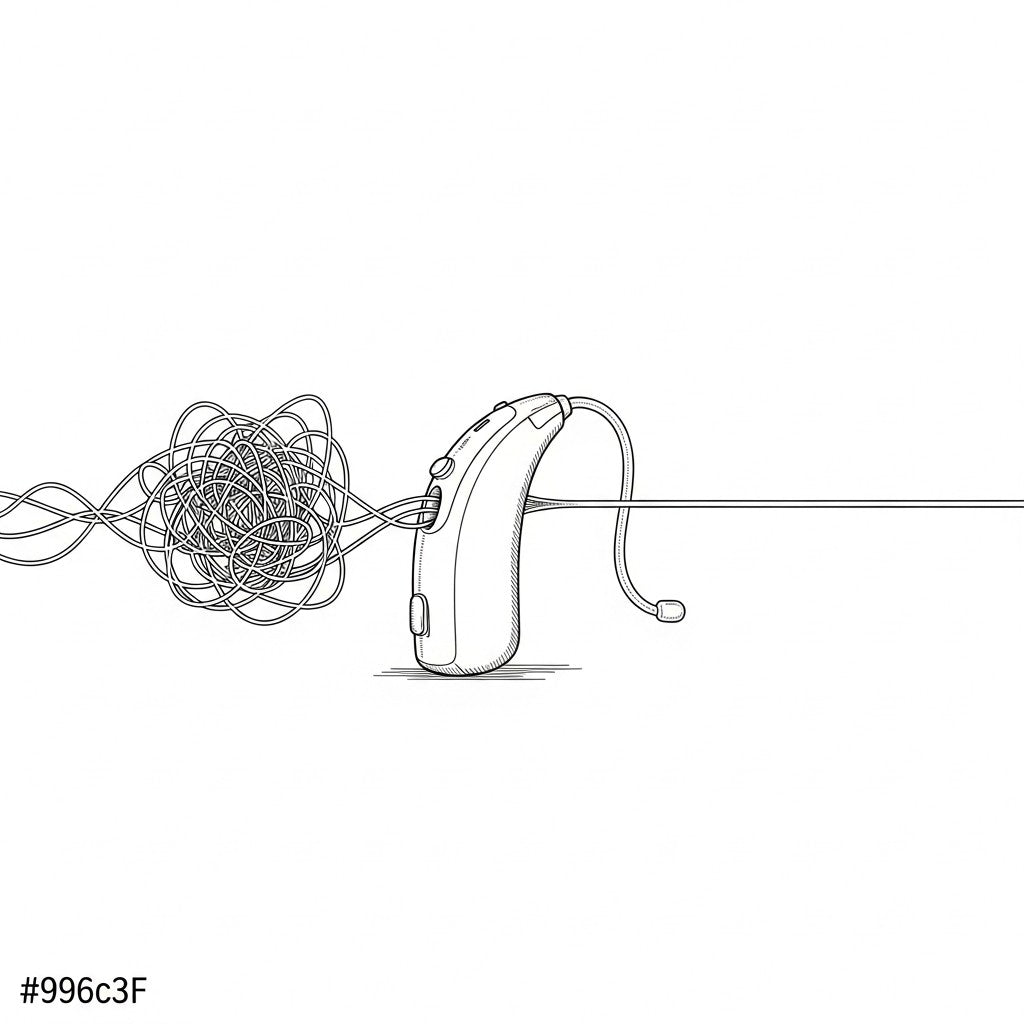
"I Can Hear But I Can't Understand": The Hidden Signs of Hearing Loss

Have you ever found yourself in a bustling café, surrounded by clinking cups and overlapping conversations? You can hear the sounds clearly, yet the words spoken by the person sitting across from you seem to vanish. You nod, smile, and try to keep up—but the connection feels lost.
If this sounds familiar, you are not alone. The experience of hearing sounds without understanding speech is one of the most common—and most misunderstood—early signs of hearing loss.
The Difference Between Hearing and Understanding
Hearing and understanding are not the same process. Hearing is the ear’s ability to detect sound. Understanding, also known as auditory processing, is the brain’s ability to interpret those sounds into meaningful speech.

A frequent cause of this disconnect is high-frequency hearing loss. While low-frequency sounds provide volume, high-frequency sounds—especially consonants like s, f, th, sh, k, p—give speech clarity and meaning.
When high-frequency sounds are reduced, speech may sound loud enough but unclear. This is why many people feel others are “mumbling,” when in reality, essential speech details are missing.
Are You Experiencing These Hidden Signs of Hearing Loss?
Hearing loss often develops gradually, making early symptoms easy to dismiss. You may recognise yourself in some of the situations below.
Sign of Hearing Loss |
What You May Experience |
|---|---|
| Difficulty in noisy environments |
Restaurants or social gatherings feel exhausting and overwhelming. |
|
Frequent requests for repetition
|
You regularly ask others to repeat themselves. |
|
Increased TV or radio volume
|
Others comment that the sound is too loud. |
|
Trouble with phone conversations
|
Understanding speech without visual cues is difficult. |
|
Difficulty with certain voices
|
Women’s and children’s voices are harder to follow. |
|
Listening fatigue
|
You feel mentally drained after conversations. |
|
Social withdrawal |
You avoid situations that require active listening. |
If several of these experiences apply to you, we recommend that you investigate your hearing health further with an ENT and get a hearing test done.
When Your Hearing Test Is “Normal”: Hidden Hearing Loss
Many people are told their hearing is “normal” after a standard test—yet they continue to struggle with understanding speech. This can be explained by hidden hearing loss.
Traditional hearing tests measure how well you hear sounds in quiet environments. However, real-life listening involves background noise, where hidden hearing loss becomes most noticeable.
Research suggests this condition may be linked to weakened connections between the inner ear and the auditory nerve, meaning sounds are detected but not transmitted clearly to the brain.
Another related condition is Auditory Processing Disorder (APD), where the brain struggles to process sound even when the ears function normally.
Auzen insight: If you feel something is wrong with your hearing, your experience is valid—even if previous test results appeared normal.
How to Get a Clear Diagnosis
A complete hearing assessment may include speech-in-noise testing, designed to evaluate how well you understand speech in real-world conditions. Seek
As a first step, an online hearing screening can help you understand your current hearing profile.
From Muffled to Clear: Hearing Solutions That Help

Modern hearing aids do far more than increase volume. They selectively amplify high-frequency sounds and reduce background noise, improving clarity and comfort.
Features such as directional microphones and noise management help you focus on conversations—even in challenging environments.
Additional accessories, such as TV streamers and remote microphones, can further enhance specific listening situations.
The Auzen Approach to Hearing Care
Auzen offers modern, personalized hearing care through online consultations and tele-audiology. Our hearing experts support you from assessment to fine-tuning—entirely from home.
We provide advanced hearing aids equipped with the latest technology, ensuring solutions tailored to your lifestyle and hearing needs.
Don't Just Hear—Understand
Struggling to follow conversations or feeling exhausted from listening is not something you have to accept. With the right support, clarity and confidence can return.
Reconnect with conversations and enjoy life without constant listening effort.

Leave a comment
This site is protected by hCaptcha and the hCaptcha Privacy Policy and Terms of Service apply.